

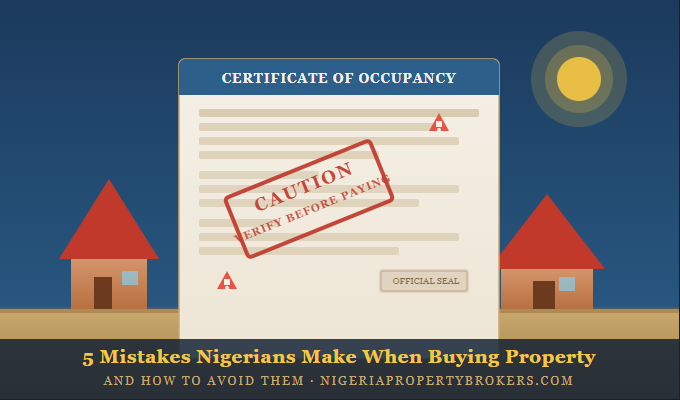
Buying property in Nigeria is one of the biggest financial decisions you will ever make. Whether you are purchasing land in Ibeju-Lekki, a flat in Ikeja or Lekki or a home in Abuja, the stakes are high and so are the risks. Every year, thousands of Nigerians lose millions of naira to avoidable mistakes such as fake titles, unverified agents, rushed decisions, and overlooked legal details.
We have helped hundreds of buyers complete safe, successful transactions across Lagos, Abuja, Port Harcourt, and beyond. In this guide, we share the five most common and most costly mistakes buyers make, and exactly how to protect yourself.
Mistake 1: Buying Property in Nigeria Without Verifying the Title
This is the single most common cause of property loss in Nigeria. A seller shows you a document — a Certificate of Occupancy, a deed, or a receipt from a previous transaction — and you take it at face value. Weeks or months later, after you have paid, you discover the title is fake, disputed, or covers a completely different plot.
What you should do instead:
Every property title must be verified at the appropriate land registry before any money changes hands. In Lagos State, this is done at the Lagos State Land Registry in Alausa, Ikeja. In Abuja, verification goes through the FCT Land Administration. For a Certificate of Occupancy (C of O), confirm the file number, the registered owner’s name, and that the land is not encumbered (i.e., not used as collateral for a loan or apportion by the government for future development).
The documents to look out for and verify include:
- Certificate of Occupancy (C of O) — the strongest form of title that confirms the ownership of the land for 99 years
- Governor’s Consent — required when a C of O property changes hands to another buyer
- Registered Survey Plan — confirms the exact coordinates and boundaries of the property you want to buy
- Deed of Assignment — shows the history of ownership transfers to the new buyer
- Excision — for lands in areas that were originally under customary ownership of the government and want to return the lands to the original owners
Do not skip this step, no matter how trusted the seller appears to be. A legitimate seller will always welcome verification on any property they want to sell.
Mistake 2: Buying From Unverified Agents or Developers
Nigeria’s real estate market has no shortage of people who present themselves as agents, brokers, or estate developers — many of whom have no license, no office, and no accountability. Some are outright fraudsters. Others are genuine but simply incompetent. Either way, the buyer suffers.
Red flags to watch for:
- The agent cannot provide a verifiable business address or registration
- The price is significantly below market rate (“we’re giving it cheap because we need quick sale”)
- You are pressured to pay quickly before “another buyer takes it”
- There is no written agreement — only verbal promises
- The developer cannot show approved building plans or land title
What you should do instead:
Work only with agents or developers who are registered with the Estate Surveyors and Valuers Registration Board of Nigeria (ESVARBON) or members of the Nigerian Institution of Estate Surveyors and Valuers (NIESV) or if you are want to invest in Lagos, the real estate professional must be registered with Lagos State Real Estate Regulatory Authority (LASRERA). Ask for their registration number and verify it.
When buying through our platform, Nigeria Property Brokers, every listing is connected to a named, contactable agent. If anything feels off, contact us directly at support@nigeriapropertybrokers.com before making any payment.
Mistake 3: Buying Property in Nigeria Without a Physical Inspection
It sounds obvious, but many buyers especially diaspora Nigerians purchasing from abroad, or investors buying purely on the basis of price, never physically visit the property before paying. They rely on photos, videos, or descriptions from the seller. This is a serious mistake.
Photos can be:
- Taken years ago before the property deteriorated
- Edited or taken from a neighbouring property entirely
- Misleadingly framed to hide drainage issues, proximity to a dumpsite, or flooding
Beyond the property itself, a physical visit lets you assess:
- Road access (is it motorable in all seasons, including rainy season?)
- Proximity to amenities — markets, schools, hospitals, petrol stations
- Neighbourhood security and general development
- Whether the estate infrastructure (roads, drainage, perimeter fence) actually exists
- The actual size and boundaries of the land
What you should do instead:
Always visit in person before payment. If you are in the diaspora and cannot travel, commission a trusted third party — a lawyer, a friend, or a verified agent to inspect on your behalf and report back with a video walkthrough. Nigeria Property Brokers can arrange physical inspection visits for buyers in Lagos. Contact us to arrange one.
Mistake 4: Buying Property in Nigeria Without a Property Lawyer or a Registered Surveyor
Many Nigerian buyers try to save money by skipping a lawyer or a register surveyor. They ask the seller’s agent to handle all the paperwork, not realising that the seller’s agent is legally working in the seller’s interest and not theirs.
A property lawyer:
- Reviews the title and flags any defects before you commit funds
- Conducts a search at the land registry on your behalf
- Drafts or reviews the Sale Agreement and Deed of Assignment to protect your rights
- Ensures Governor’s Consent is properly obtained (if applicable)
- Verifies that all statutory fees — Capital Gains Tax, Stamp Duty — are properly handled
- Confirms that the property has no outstanding charges or government acquisition notices
The cost of a property lawyer in Nigeria typically ranges from 5% to 10% of the purchase price for a standard residential transaction — a small fraction of what you stand to lose without one.
What you should do instead:
Engage your own independent lawyer or registered surveyor and not the one recommended by the seller or developer. Brief them fully, give them time to conduct proper searches, and do not make any significant payment until they have reviewed and approved the transaction.
Mistake 5: Buying Property in Nigeria in Government Acquisition Areas
This is a trap that catches even experienced buyers. The Lagos State Government, the Federal Capital Territory Administration, and other state governments have acquired large swathes of land across Nigeria for public purposes — roads, schools, housing schemes, and infrastructure projects. These acquisition notices are sometimes decades old and not widely known.
Buying land in an acquired area means the government can demolish your property and return the land with little or no compensation. This has happened repeatedly in areas of Lagos and Abuja, often leaving buyers with nothing.
Areas that have historically had acquisition issues in Lagos include parts of Ajah, Lekki, Victoria Island environs, and some portions of Ibeju-Lekki. This does not mean all land in these areas is affected, but it underscores the importance of verification.
What you should do instead:
Your lawyer’s or registered surveyor search at the land registry will typically reveal whether an acquisition notice exists on a plot. In Lagos, you can also verify through the Lagos State Ministry of Physical Planning and Urban Development. For new estates and developments, ask the developer to provide a copy of the Excision document — proof that the land has been formally released from government acquisition or a Gazette if applicable.
If a developer cannot produce this documentation, walk away.
Final Word: Safe Property Buying Is Possible
Nigeria’s property market has genuine opportunities. Prices in areas like Ibeju-Lekki, Mowe-Ofada, and Abuja’s satellite towns continue to rise, and verified properties are delivering strong returns for buyers and investors alike. The key is doing things the right way by taking your time, using qualified professionals, and refusing to be rushed.
At Nigeria Property Brokers, every listing on our platform is linked to a named, reachable agent. We encourage all our buyers to conduct due diligence, involve a lawyer, and inspect before they invest. We are here to help at every step.
Ready to start your property search the right way?
👉 Browse verified listings 👉 Book a free consultation with our agents 👉 WhatsApp us directly: +234 805 544 4556
Nigeria Property Brokers is a verified real estate platform connecting buyers, sellers, landlords, and tenants across Lagos, Abuja, Port Harcourt, Enugu, and beyond. All listings are agent-linked and inquiry-ready.
Tags: buying property Nigeria, land title verification Nigeria, property scam Nigeria, how to buy land Lagos, real estate tips Nigeria, C of O Nigeria, property lawyer Nigeria
Category: Real Estate Guide, Buyer Education
Meta description (for SEO — paste into Yoast/RankMath): Avoid costly property mistakes in Nigeria. Learn the 5 most common errors buyers make — fake titles, unverified agents, skipping lawyers — and how to protect yourself.


Join The Discussion